

Ellis Amdur – Robert Hubal: The Good Stranger
Managing Intense Interactions Within Social Services Environments
Professional Series N.3
42.00 USD



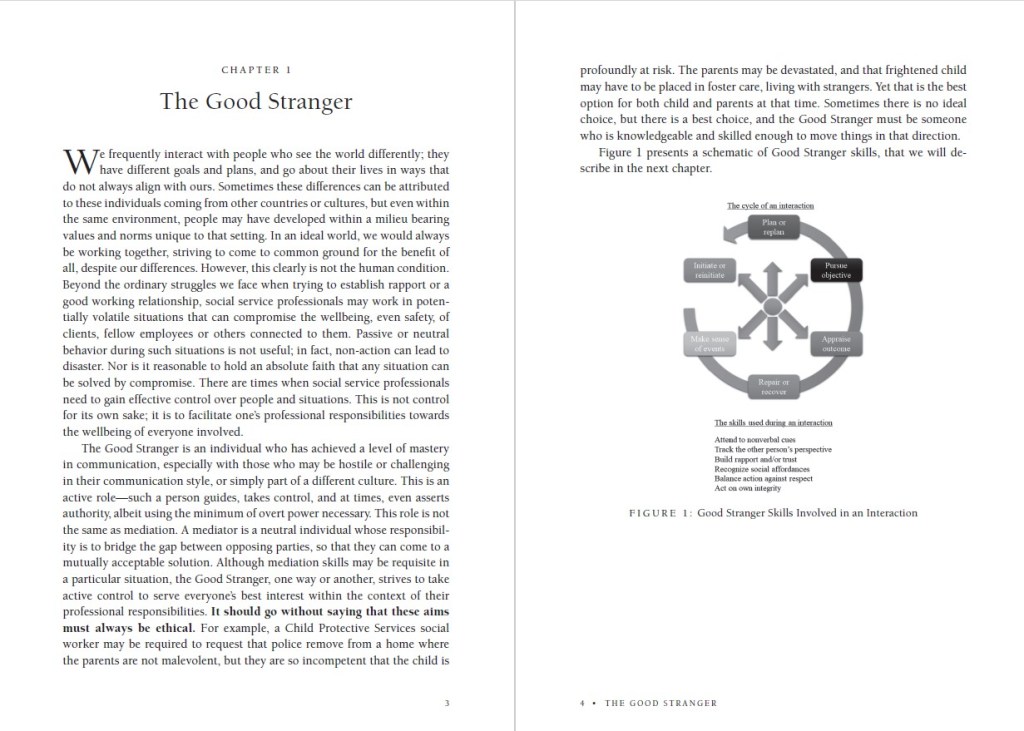
Encountering individuals who are struggling—whether due to mental illness, intoxication, instability, or advocacy conflicts—is almost inevitable when working in social services. Such situations often involve people who are emotionally flooded, confused, or have conflicting perspectives. How can you prepare for these interactions to prevent them from going awry while maintaining a calm demeanor and focusing on shared goals and successful outcomes?
In The Good Stranger, Ellis Amdur and Robert Hubal share their extensive experience working with social service agencies to train and develop essential social interaction skills for handling intense, problematic situations. They emphasize the importance of establishing rapport, managing crises, and de-escalating aggression. The Good Stranger is someone who strives to reach accord with others, while maintaining focus on their goals, building trust and engaging others with professionalism, integrity, and respect.
“The Good Stranger by Ellis Amdur and Robert Hubal delves into the unique abilities of individuals who thrive in unfamiliar social settings, even without shared history, language, or culture. The authors bring the concept of “Good Strangers,” (originally developed by myself and Jonathan Wender in 2008) to a wider audience.
Good Strangers are experts who navigate and create co-regulated interactions in tense encounters. Drawing from police and military studies, much of which they were involved in as researchers and practitioners, they have extended the reach of that research beyond its original scope into social service and clinical settings.
Amdur and Hubal emphasize bridging social, cognitive, and perceptual divides within the full range of social interactions, not just those arising from mental health or interpersonal crises. Thus, it is a book that has a much wider scope than texts on de-escalation and crisis intervention.
The Good Stranger is an essential and practical field guide for anyone in social services who must coordinate and manage volatile situations, and the unique individuals and groups within them”.
– Brian Lande, PhD (Chief Science Officer at Polis-Solutions, founding program manager of the DARPA “Good Stranger” program, and veteran Police Sergeant).



Product details
ASIN: B0FCRMG9V7
Publisher: The Ran Network
Publication date: June 10, 2025
Language: English
Print length: 300 pages
ISBN-13: 979-8312386028
Item Weight: 658 gr
Dimensions:17.78 x 1.73 x 25.4 cm
Part of series: Professional Series (N. 3)
Table of Contents
SECTION I: Introduction to the Good Stranger
CHAPTER 1: The Good Stranger
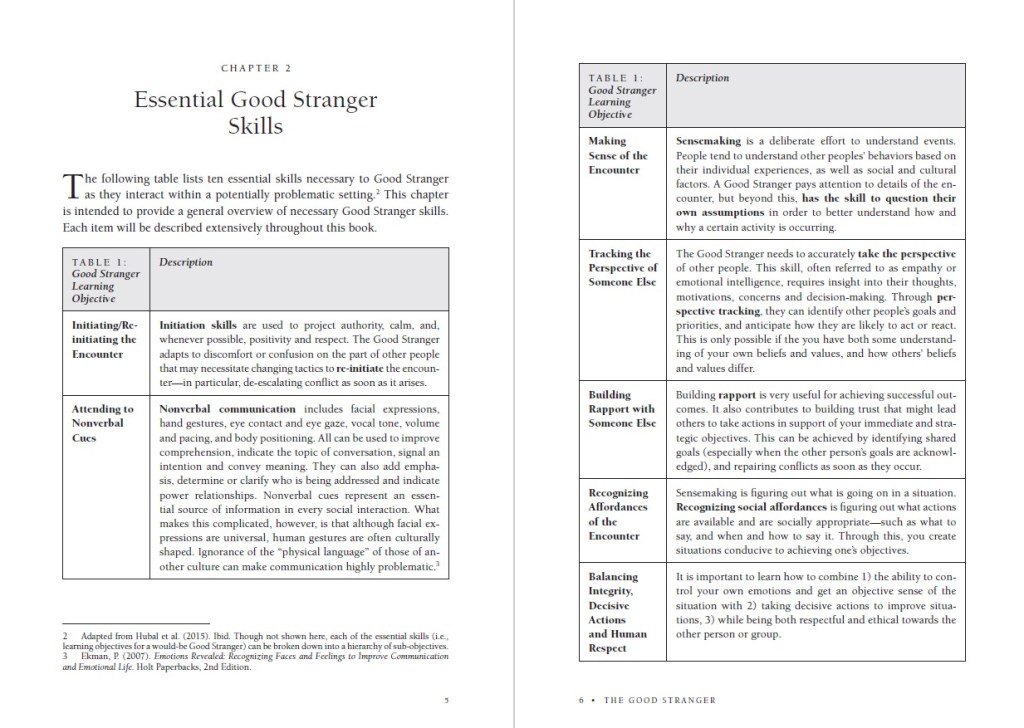
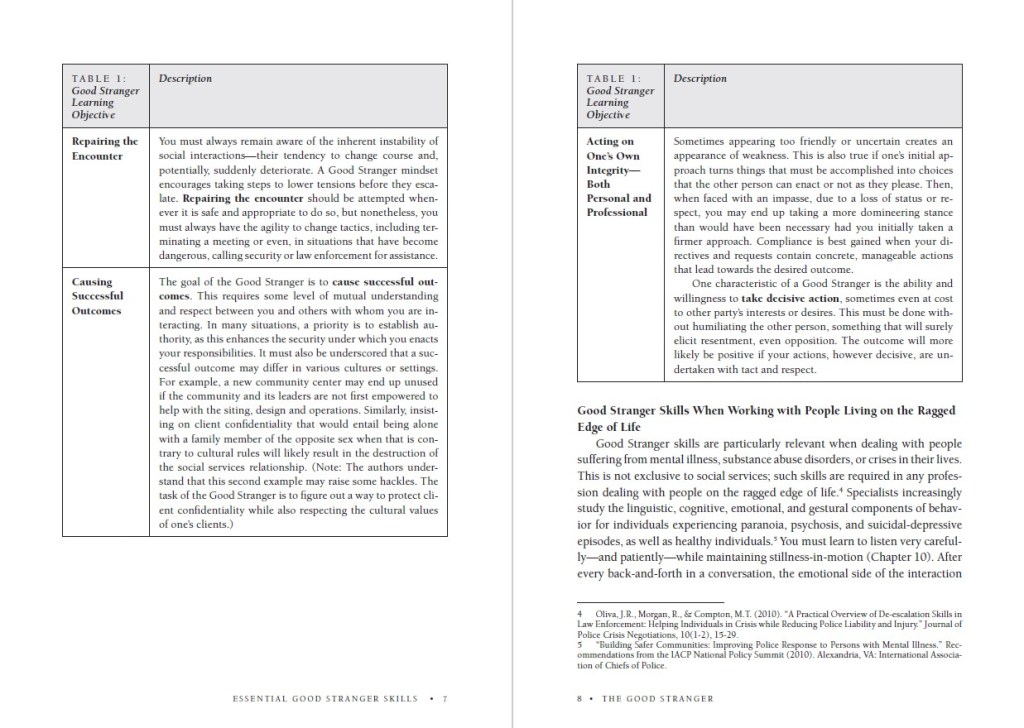
CHAPTER 2: Essential Good Stranger Skills
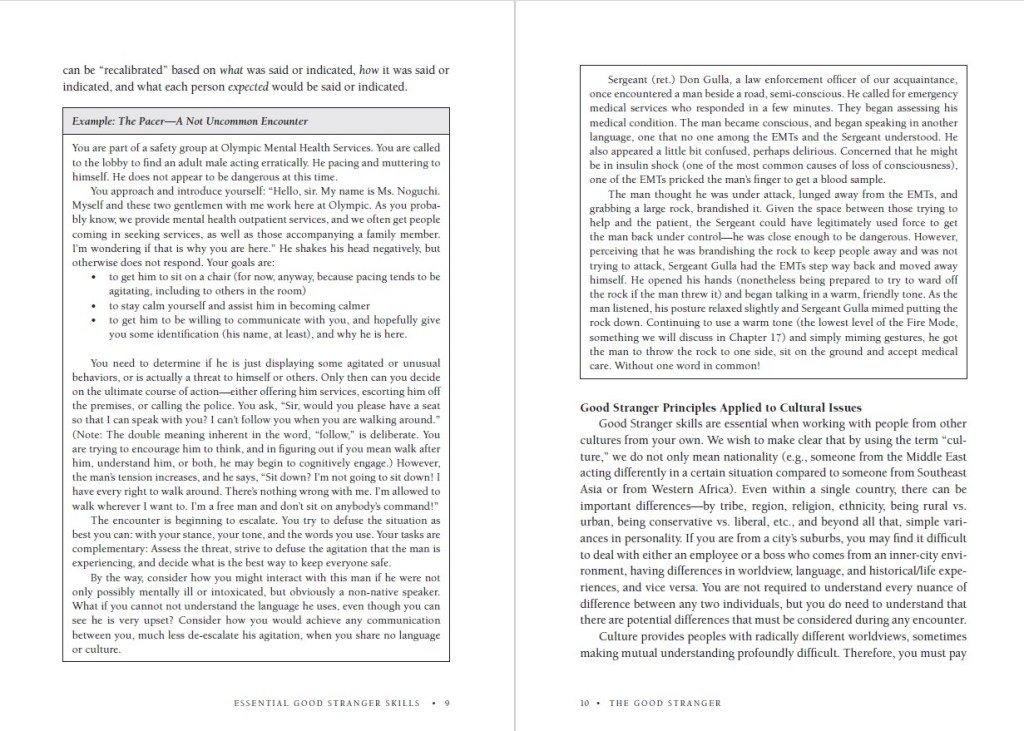
Good Stranger Skills When Working with People
Living on the Ragged Edge of Life
Good Stranger Principles Applied to Cultural Issues
Crisis Stages
SECTION II: Composure: Standing with Strength in Crisis Situations
CHAPTER 3: Coordination of Self
Grace Under Fire
CHAPTER 4: It’s Not Personal Unless You Make It So
CHAPTER 5: No One Will Own Me
CHAPTER 6: Tactical Breathing—Be the Eye in the Center of the Hurricane
Circular Breathing Method #1—Front to Back
Circular Breathing Method #2—Back to Front
How Should You Practice Circular Breathing?
When Should You Use Circular Breathing?
CHAPTER 7: Alternative Breathing Methods for Intense Situations
Numbered Breathing
Matching Breaths
CHAPTER 8: The Intoxication and Joy of Righteous Anger
Protecting Your Family and Team from What You Otherwise Would Bring Home
SECTION III : Beyond the Basics—Core Elements Necessary to
Manage Intense and Problematic Situations
CHAPTER 9: Core Elements
CHAPTER 10: Stillness-In-Motion—Your Physical and Attitudinal Stance
Flow of Dialogue
CHAPTER 11: Correct Distance
Boundaries: Correct Distance for Social Services Professionals
The Texture of Relationship
CHAPTER 12: Eye Contact
CHAPTER 13: Interweaving
Bracketing
Scanning
Entry
Regulating
CHAPTER 14: A Few Angles on Bias
My Way Is the Only Way (aka Egocentricity Bias)
Attribution Bias
Confirmation Bias
CHAPTER 15: Working With, Not Against Pattern Biases
Loss Aversion
Differentiation
Commitment and Consistency
CHAPTER 16: Positive Cognitive Dissonance (Undermining the Other’s Biases Towards the Good Stranger)
CHAPTER 17: The Balancing Powers—Fire & Water
Fire
Water
Shifting Between Water and Fire
SECTION IV: What to Say and How to Say It
CHAPTER 18: A Strategic Approach to Good Stranger Skills
CHAPTER 19: A Deeper Look At Social Affordances
The Negative Stances that Undermine One’s Abilities As a Good Stranger
A Social Affordance in Tense Family Situations: The Jungle Guide
A Social Affordance in Tense Family Situations: A Gift
CHAPTER 20: Meaning-Focused Paraphrasing
How to Master Meaning-Focused Paraphrasing
CHAPTER 21: Pros and Cons of Different Types of Response
CHAPTER 22: Ten FAST POINTS For Good Strangers
Focus on the Future
Avoid Absolutes
Stance
Time Management
Personalize & Provide Direction
Open Response & Observe
Invest
No Assumptions, No Speculation
Talk Like a Human Being
Success
SECTION V: Training Yourself to Be a Good Stranger
CHAPTER 23: Embodying Good Stranger Skills
CHAPTER 24 : Becoming a Good Stranger
CHAPTER 25 : Self-Bias—The Ultimate Impediment
SECTION VI : Responding to Those with Intense Personality Styles
CHAPTER 26 : Be At Your Best by Preparing for the Worst
CHAPTER 27 : Firewalls and Dikes
CHAPTER 28 : The Emotional/Reactive Style
Good Stranger Response to the Feeling/Emotions-based Individual
CHAPTER 29 : Honor and Shame
CHAPTER 30 : The Dramatic/Attracting Style
CHAPTER 31 : The Hypersensitive/Paranoid Style
The Personal Is Political
Omni-Directional Grievance/Resentment/Hypersensitivity
Tactical Interaction with Hypersensitive/Paranoid Individuals
CHAPTER 32 : The Unethical Person—Pure Self-Interest
CHAPTER 33 : The Self-Centered/Narcissistic Style
The Difference Between the Dramatic/Attracting Style and the Narcissistic Style
Good Stranger Tactics with Those Who Express the Self-centered/Narcissistic Style
Narcissism of the Weak
CHAPTER 34: The Predatory Style
Good Stranger Tactics with Those Who Express the Predatory Style
Predatory Individuals within Social Services
Cryptic Consequences: An Important Strategy for the Good Stranger
CHAPTER 35: The Eccentric/Mentally Disordered Style
SECTION VII: Good Stranger Scenarios for Social Services
CHAPTER 36: Scenarios for Social Services
Dealing with a Family Member Who Is Undermining a Deal
Dealing with a Repetitive Demand
Helping A Profoundly Frightened Individual
Dealing with Someone Demonstrating Suspiciousness,
Hypervigilance, or Hair-Trigger Reactivity
Disrespect to Earn Social Status
Dealing with an Exploitative, Predatory Individual
Dealing with Someone Whose Mindset (Either Culturally Based, or Merely a Personal Code) Is Based on Maintaining
Honor and Avoiding Being Shamed
Dealing with a Depressed, Potentially Dangerous Individual Who Blames Others for His Own Guilt—
A Death of Innocents
SECTION VIII: Putting It All Together
CHAPTER 37 : A Review
Initiation
Nonverbal Communication
Sensemaking
Recognizing Social Affordances
Perspective Tracking (Empathy)
Building Rapport
Decisive Action
Repair
Successful Outcomes
Respect, Goal Direction, Trust, and Integrity
CHAPTER 38 : Good Stranger Skills In Alternative Contexts
Good Stranger Skills At A Distance—A Consideration Of Communication Through Electronic Media
Suggestions For Good Stranger Interactions Within A Group
CHAPTER 39 : Final Word
 The Ran Network